
Authorized by: Abigail Deutsch
By: Vaericia Meno
At midnight on October 8, 2009, about 50 people gathered on the sidewalk before Baltimore’s Westminster Church. Some wore jeans. Some wore pajamas. Some wore capes and gowns and girdles. The drivers rolling down Fayette Street slowed to peer at the assembly, which bulged beyond the curb, into the path of traffic. A black-cloaked figure dominated the open church doorway, shouting the jangling rhymes of Edgar Allan Poe’s “The Raven.” On the periphery of the church sprawled the graveyard containing Poe’s remains.
A passing cabbie bellowed: “What is this?”
On October 3, 1849, a 40-year-old Poe appeared in a Baltimore tavern, wearing a stranger’s clothes, suffering an unidentifiable condition. Too incoherent to explain himself to the authorities, he died in the hospital on October 7. He was buried in an unmarked grave in the Poe family plot, and only a handful of guests attended the funeral. No one ever discerned the cause of death, though explanations ranging from alcoholism to syphilis to rabies have surfaced over the years.
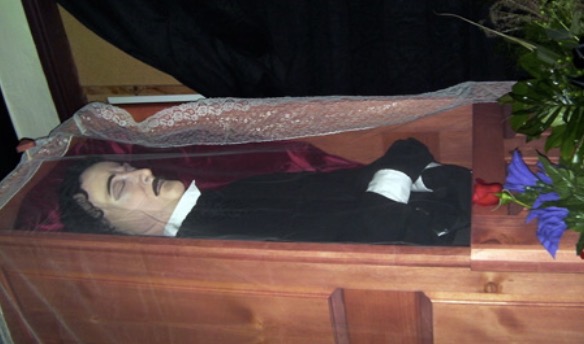
The year 2009 marked not only the 160th anniversary of Poe’s death but also the 200th of his birth, and that October weekend, Baltimore offered a series of funerary fetes: first an open-casket viewing of Poe’s “corpse”—actually a latex replica sporting a suit—followed by the all-night churchyard vigil described above. A few days later, Westminster Church hosted two funerals in a single afternoon. Before the first ceremony, a horse-drawn hearse carried the corpse to the church from the nearby Poe House (the author’s former home, which has since become a museum). Then actors portraying Sarah Helen Whitman, Charles Baudelaire, H. P. Lovecraft, and others whom Poe affected offered him tributes before an audience of 350 people. Several hours afterward, the performance recurred.
The most famous word of Poe’s most famous poem presents a paradox. “Nevermore” first appears midway through “The Raven.” Even though its meaning—and its position at the end of a stanza—generates a sense of conclusion, it becomes a refrain, repeatedly insisting on the unrepeatable.